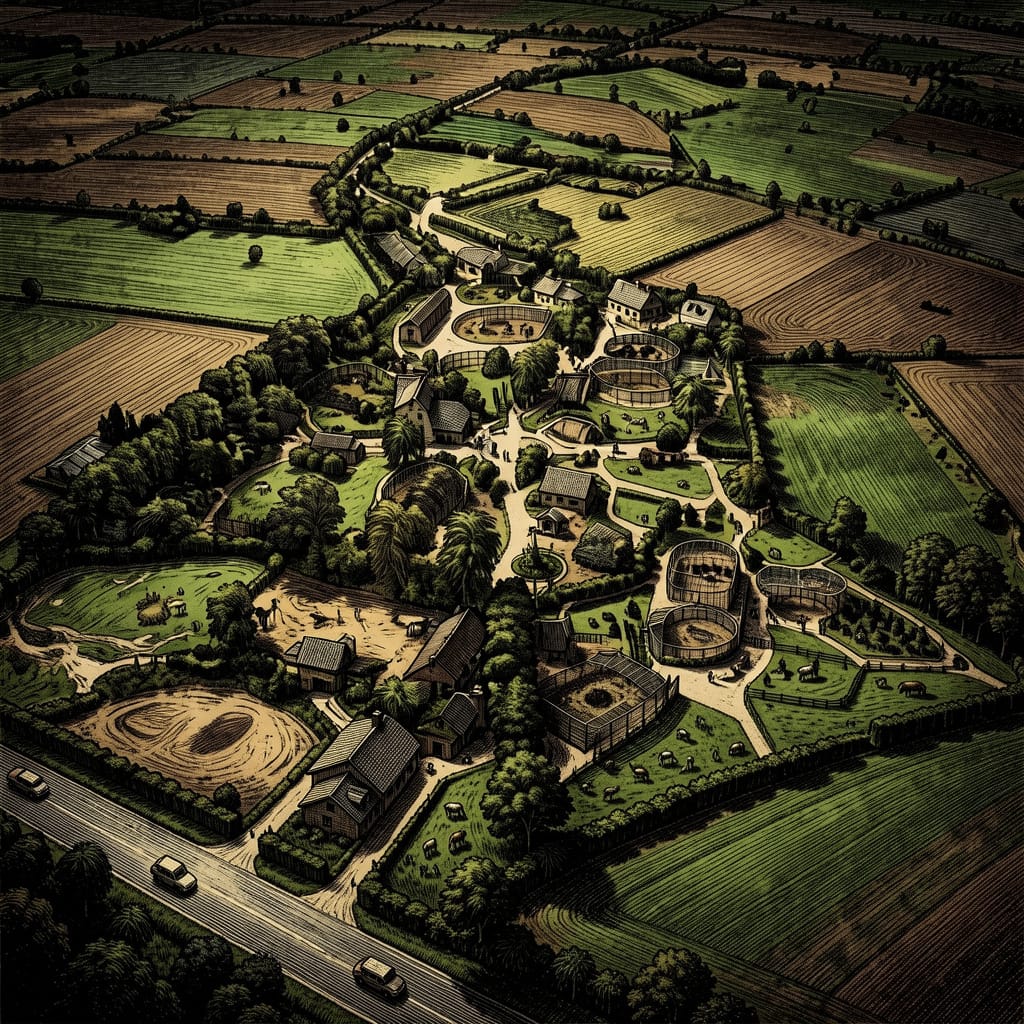
Twycross Zoo is the third and last of the trips Toby Knight arranges in Chapter Twenty-Two: Exits and Entrances, following Blackpool and Alton Towers. The zoo looks tired from the outside — weathered brick, a sagging fence, a faded cartoon gorilla over the gate, the car park turned to standing water by recent rain — and Robert is given the choice of primates or the petting zoo at the entrance. He chooses primates.
The chimp enclosure holds his attention first: one chimp sits utterly still, unhurriedly shredding a leaf, and meets Robert's stare without blinking even as a nearby child shrieks and slaps the glass. Ben quietly shields him from the noise without being asked. At the gibbons, Toby reads from the signboard and demonstrates brachiation; in the Tropical House, heat and wet air close in at once around tamarins, fruit bats and a wooden bridge over a turtle pond, Toby lingering at each enclosure while Ben leads the way.
The reptile house holds the chapter's most unsettling beat. Behind glass, an alligator lies so still it could be mistaken for a sculpture — until its eyes open, and fix on Robert, old and patient and waiting. In his own reflection in the glass, something shifts: not wrong, exactly, but altered, as if whatever was looking back had heard him thinking and hurried to wear his own face before he noticed. It lasts less than a second, and the reflection settles back into his own. Robert understands, without being able to say so, that the creature was not watching him so much as seeing him — seeing exactly what three weekends of day trips have been built around outrunning.
Ben, misreading the moment entirely, checks the thickness of the glass and the seal at its frame and murmurs that it's secure, that nothing is getting out of there — reassurance aimed at the alligator, when Robert's fear was never the alligator at all. Robert says nothing — he has learned, over the three trips, that the things he cannot explain are exactly the things Ben most needs to be able to fix, and that some things cannot be fixed, only stood next to.
The rest of the visit settles back into ordinary warmth: the children's farm, where a goat's tongue against his palm startles a real, unguarded laugh out of him; the conservation centre, where a rehabilitating kestrel grips a handler's glove; the gift shop, where he chooses a rubber snake and a pencil topped with a grinning monkey while Ben counts out the cash. At the gate, Ben's eyes flick across the car park — one, two, three — the same automatic check he runs everywhere, before the turnstile clicks them through and the three weekends of trips come quietly to an end.